

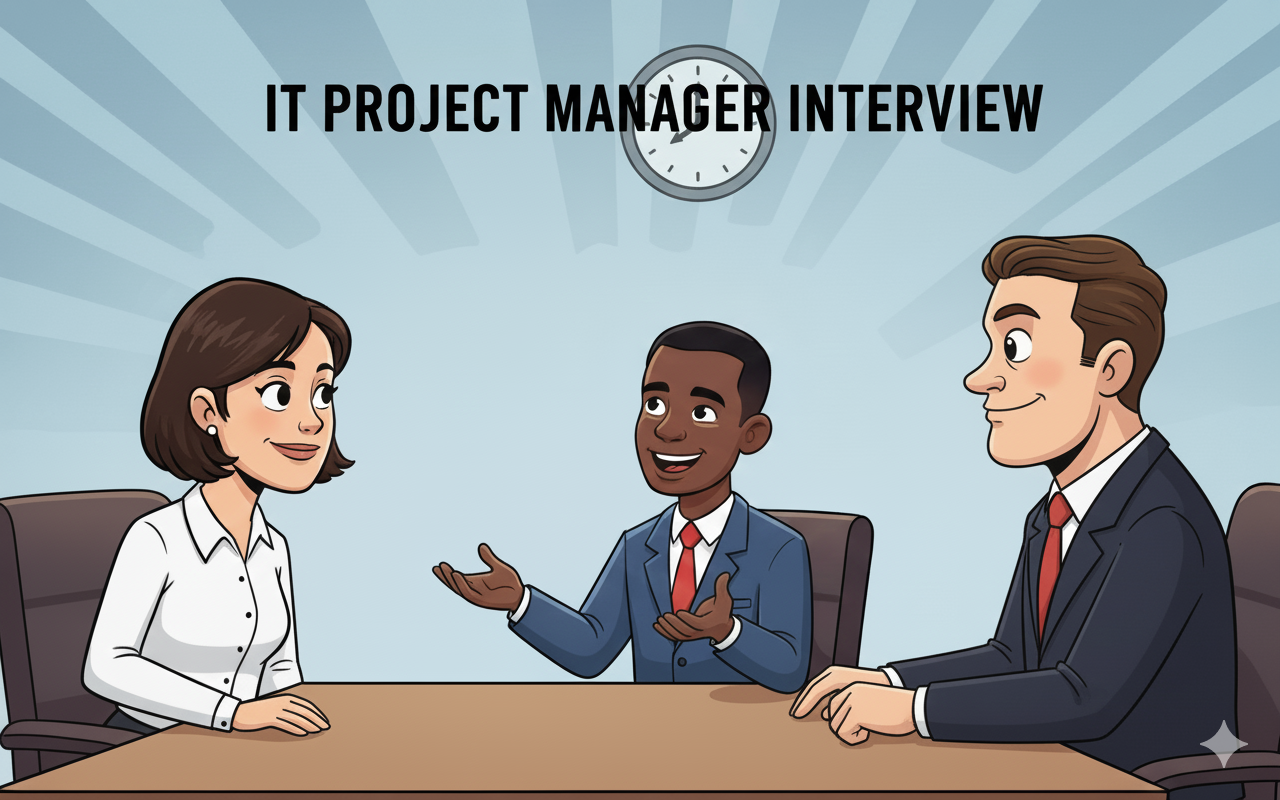
Landing an IT Project Manager role at a bank isn’t just about technical prowess or project delivery experience – it’s about demonstrating a unique blend of strategic thinking, risk awareness 🛡️, and an understanding of the highly regulated financial landscape. In the fast-paced world of banking, IT projects are the backbone of innovation, compliance, and customer experience. But how do you stand out in a competitive interview process and truly impress your future line manager? 🤔
This guide dives deep into what it takes to ace an IT Project Manager interview, specifically tailored for the banking sector. We’ll uncover not only the five unconventional preparation steps that will set you apart from other candidates ✨ but also the five critical “unspoken” expectations your new manager will have – the things they often don’t tell you, but absolutely need you to know. Get ready to transform your interview approach and secure that coveted banking IT Project Manager position! 💼🏆
Part 1: 5 Things to Do That Others Do Not Normally Do (The Stand-Out Strategy)
Most candidates will review the job description, company website, and common PM interview questions. To truly shine, you need to demonstrate a deep, proactive understanding of the specific environment (banking/finance) and how IT projects drive its success and manage its inherent risks.
- Research the Bank’s Recent Regulatory/Compliance Fines or Initiatives 🚨: Banks operate under heavy regulation. A candidate who proactively finds the bank’s recent compliance challenges (e.g., POPIA/GDPR, AML, data privacy, capital requirements) shows they understand that every IT project has a compliance and risk component, not just a technical one. This speaks directly to senior management’s biggest concerns. Be ready to discuss how you’ve factored regulatory changes into project scope or timelines.
- Map a Current IT Project to a Business Metric 📈: Instead of a generic project story, prepare an example (e.g., a past project) and frame its success not just on time/budget but on a bank-relevant metric: reducing transaction processing time (customer experience), reducing security vulnerabilities (risk), or improving data quality (regulatory reporting). This demonstrates that you think like a business leader, not just a project coordinator.
- Prepare 2-3 Tailored Questions for Each Interviewer Role 🗣️: Don’t just ask generic questions. Have specific, insightful questions ready for the HR person (e.g., culture, training budget for PMs), the Hiring Manager (e.g., strategic roadmap, PMO maturity, biggest IT challenges in the next 12 months), and a potential IT Team Member (e.g., technical debt, dev ops maturity, existing pain points in collaboration). This demonstrates an understanding of the entire stakeholder ecosystem and your proactive engagement.
- Create a 30-60-90 Day Plan Focused on Team & Governance 🗓️: Instead of a generic plan, create one focused on your initial actions with the project team and establishing governance. Outline the first team meeting’s agenda: listening tour, setting a communications charter, defining “done,” and identifying the current major roadblock. This shows practical, servant-leadership focused on team dynamics and immediate, structured traction within a regulated environment.
- Discuss “Slowing Down” an IT Project (and Why) 🐢: All PMs talk about speed and delivery. A great bank PM talks about quality, governance, and risk mitigation. Prepare an answer about a time you intentionally slowed down or paused a project to conduct deeper risk analysis, enhance testing for a critical regulatory change, or re-engage an executive sponsor due to shifting priorities. This demonstrates maturity and an understanding of the bank’s aversion to risk over unchecked speed.
| Research Area | Key Focus Points | How to Apply in the Interview |
| The Bank Tech Strategy | Digital Migration: The Bank is likely heavily focused on its App, digital channels, and GenAI (Generative AI) integration. They want customers on their app to enhance experience and reduce fraud. | Frame your projects around “migration,” “digital adoption,” and “customer experience” (e.g., “My goal was a 15% migration to the new digital process”). |
| South African Regulation | POPIA & FAIS: Understand that POPIA (Protection of Personal Information Act) compliance is non-negotiable for all IT projects. Anti-Money Laundering (AML) and FICA requirements drive system changes. | Use terms like “Data Sovereignty,” “Compliance-driven roadmap,” and “Risk-adjusted prioritization” when discussing scope and planning. |
| Project Methodology | The Bank is a large enterprise, likely using a blended methodology. Expect a formal PMO (Project Management Office) and a reliance on frameworks like COBIT 5 (for IT Governance) and PMBOK/Prince2, often with an Agile/Scrum flavour for execution. | Be methodology-agnostic but governance-centric. State you use the approach that fits the project: “I use Agile for speed and Waterfall for auditability of financial systems.” |
| Key IT Priorities | Cybersecurity, data science, AI, and internal system modernization for operational efficiency. They also have an ESG (Environmental, Social, and Governance) focus. | Be prepared with a story about a cybersecurity or data governance project, or how you incorporated an ESG metric into a project’s benefits realization. |
Part 2: What Your New Line Manager Might Not Tell You (The Unspoken Needs)
These are the critical expectations that define success in a highly regulated, risk-averse environment like a bank, which are often assumed rather than explicitly stated.
- The Real Role of the Project Sponsor is Compliance/Audit Shield 🛡️: The official role is providing strategic direction, but the unspoken need is for the PM to manage all project documentation (risks, decisions, scope changes, audit trails) so thoroughly that the Sponsor can confidently present it to Internal Audit or Regulators at any time. Your rigour protects them and the bank.
- You are a Political Translator, Not Just a Coordinator 🗣️🔄: IT projects in a bank often involve complex conflicts between Business vs. IT vs. Risk/Audit. The unspoken job is to translate technical realities into financial/risk implications for the business, and business/regulatory urgency into technical priorities for the team. You must navigate these political tensions daily, building bridges and facilitating consensus.
- Budget Management is About Forecast Credibility, Not Just Spending 💰: Banks rely heavily on accurate forecasting for annual budgeting and capital allocation. Your manager will care less about minor over-spends and more about a sudden, late-in-the-quarter request for more funding. Predictability and transparency in your financial reporting are the ultimate signs of a reliable PM. Be proactive with variance analysis and re-forecasting.
- Technical Debt is a Systemic Risk, Not Just an IT Problem 📉: Your manager knows that not addressing technical debt – aka Legacy Systems (old, complex, unsecure systems) creates significant risk for the whole bank. They need you to weave technical debt reduction into every project proposal, even if it adds to the cost/timeline, and advocate for it as a risk mitigation strategy, not just a “nice-to-have.”
- The True Measure of “Closure” is Flawless Handover to Operations/Support ✅: Standard closure is signing off documents. The bank reality is that a project isn’t truly done until the new system is flawlessly running in the production environment and the IT Operations/Support team has accepted full responsibility and has been properly trained. Projects often fail post-launch if this isn’t handled meticulously. Your manager needs a PM who is maniacally focused on the transition phase and post-implementation stability.
Part 3: Additional Tips for A Successful Interview 💡
- Familiarize Yourself with South African Financial Regulations (e.g., POPIA, FICA, AML) (if applicable) 🇿🇦: If interviewing in South Africa, a deep understanding of these specific regulations and their impact on data handling, customer onboarding, and transaction monitoring will be a significant advantage.
- Showcase Data-Driven Decision Making 📊: Banks are awash with data. Discuss how you use metrics, dashboards, and reporting to make informed project decisions, track progress, and communicate status to stakeholders.
- Emphasize Cybersecurity & Data Security Experience 🔒: With increasing cyber threats, demonstrating experience in managing projects with strong security requirements, compliance with data protection laws, and engaging with security teams is crucial.
- Be Ready for Scenario-Based Questions 🧩: Expect questions like, “What would you do if a critical regulatory deadline shifted mid-project?” or “How would you manage a conflict between a business unit demanding new features and the risk department pushing for stability?” Practice your STAR method responses.
- Highlight Vendor Management Skills 🤝: Many banking IT projects involve external vendors. Showcase your experience in managing vendor relationships, contracts, performance, and integrating third-party solutions.
- Understand PMO Maturity (If applicable) 🌐: Ask questions about the bank’s PMO structure, tools, and processes. This shows you’re thinking about how you’ll integrate into their existing framework.
By preparing with these insights, you won’t just be ready for the interview; you’ll be demonstrating the kind of strategic, risk-aware, and business-focused IT Project Manager that any bank would be eager to hire. Good luck! 👍
#projectmanagers #projectmanagersafrica #ProjectManagement #PMP #AgilePM #ScrumMaster #ITProjectManager #FinTech #BankingCareers #FinancialServices #RiskManagement #BankTech #CareerAdvice #InterviewTips #JobSearch #ProjectManagementJobs #Hiring #SouthAfrica #POPIA