

In the realm of Information Technology, two functions are absolutely critical to success: Project Management (PM) and IT Service Delivery (ITSD). While they often occupy different organizational spaces and have distinct goals, viewing them as separate is a mistake. As a Project Management expert, I see them as two sides of the same coin one driving change and the other ensuring stability and value.
Understanding the core differences and, more importantly, the necessary integration between these disciplines is the key to building an agile, efficient, and user-centric IT organization.
The Fundamental Divide: Project Delivery vs. Service Delivery
The clearest distinction lies in their primary focus and temporal nature.
1. Project Management: The Engine of Change 🚀
Project Management is a temporary endeavor undertaken to create a unique product, service, or result. In IT, this means:
- Focus: Delivering a defined output (a new system, a software upgrade, a data migration) within specific constraints (scope, time, and budget).
- Nature: Temporary and finite. It has a clear start and a definite end (closure).
- Goal: To deliver change or create a new capability for the business. A Project Manager is concerned with getting the ball across the finish line.
- Key Metrics: Schedule variance, budget performance (CPI, SPI), scope adherence, and successful delivery of the output.
2. IT Service Delivery: The Guardian of Value 🛡️
IT Service Delivery, often managed through IT Service Management (ITSM) practices like ITIL, is about managing the end-to-end delivery of IT services to customers.
- Focus: Providing ongoing value and maintaining a successful status quo. This includes support, maintenance, and continual improvement of existing services.
- Nature: Permanent and ongoing. It represents the “business as usual” (BAU) operations.
- Goal: To ensure the stability, availability, performance, and quality of the technology services the business relies on. A Service Delivery Manager is concerned with keeping the ball in play.
- Key Metrics: Service Level Agreement (SLA) compliance, Customer Satisfaction (CSAT), Mean Time To Resolve (MTTR), and overall service outcome.
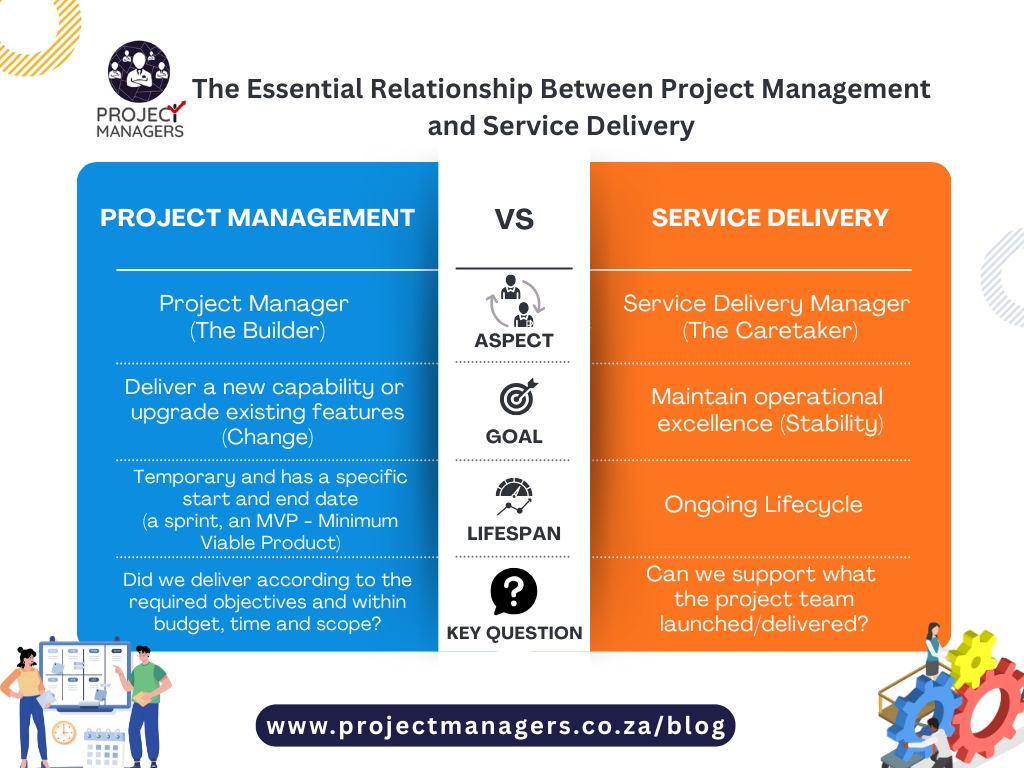
| Aspect | Project Management (PM) | IT Service Delivery (ITSD) |
| Primary Focus | Delivering a Unique Output (Change) | Delivering Ongoing Value (Stability) |
| Timeframe | Temporary (Start and End Dates) | Permanent (Ongoing Lifecycle) |
| Role | Creates a New Capability | Runs and Supports the Existing Capability |
| Success Measure | On-time, on-budget, on-scope delivery. | Meeting SLAs, high Customer Satisfaction, service availability. |
The Critical Overlap: Handover and the ITIL Lifecycle
The most vital interaction point between PM and ITSD is at the project handover. A project is not truly successful until the service it creates can be successfully and sustainably operated by the Service Delivery teams.
The IT Infrastructure Library (ITIL) framework perfectly illustrates this intersection by structuring IT management around a service lifecycle:
- Service Strategy & Design: Projects are often initiated here to create or fundamentally redesign a service. Project Managers translate strategic business needs into technical designs.
- Service Transition (The Handover Phase): This is where PM and ITSD must collaborate intensely. Project Management’s job is to deliver the change (e.g., a new application), and this delivery phase must incorporate Service Transition activities, including:
- Change Management: The project team must submit a Request for Change (RFC) to safely deploy the new service into the live environment.
- Knowledge Transfer: The PM team trains the Service Desk and Operations staff, creating documentation (knowledge articles) for ongoing support.
- Configuration Management: Ensuring the new assets are accurately recorded in the Configuration Management Database (CMDB) for future incident management.
- Service Operation: Once transitioned, the service is now “BAU” and becomes the full responsibility of the ITSD team, managing incidents, problems, and service requests.
- Continual Service Improvement (CSI): Feedback from Service Operation (e.g., recurring incidents, user dissatisfaction) triggers new projects (initiating the cycle again) to enhance or fix the service.
The Imperative for Integration
When PM and ITSD operate in silos, it creates a dangerous “throw it over the wall” scenario, resulting in:
- Unsupportable Services: Projects deliver systems that Service Delivery teams can’t monitor, patch, or troubleshoot effectively.
- Wasted Investment: Great projects fail to deliver long-term value because the ongoing operation is poor.
- User Frustration: New features break the core service, leading to increased incidents and ticket backlogs.
To remove the silos and achieve the simultaneous management of stability and innovation—organizations must strategically integrate the two:
- Involve the Service Manager Early: The Service Delivery Manager (or a representative) should be a key stakeholder and contributor to the project charter and planning phase, ensuring the solution is design-for-supportability.
- Formalize the Handover: Implement a mandatory, structured Service Transition checklist (per ITIL) that defines all required operational documentation, monitoring tools, and training sign-offs before a project can officially close.
- Cross-Functional Roles: Encourage cross-training or rotational roles. A Project Manager who understands service metrics, or a Service Manager who understands project governance, is invaluable.
- Align Success Metrics: Tie the final phase of a project’s success (project closure) to initial Service Delivery KPIs, such as a “hypercare” period where the project team remains engaged until the ITSD team confirms stability (e.g., less than
high-priority incidents in the first 30 days).
By moving beyond the traditional tension between “those who build it” and “those who run it,” IT organizations can harness the power of both disciplines to deliver not just successful projects, but also exceptional, reliable, and continuously improving services.
#ProjectManagement #ServiceDelivery #ITSM #ITIL #TechLeadership #DigitalTransformation #ITProjects #OperationalExcellence